Date:
Mar 4, 2026
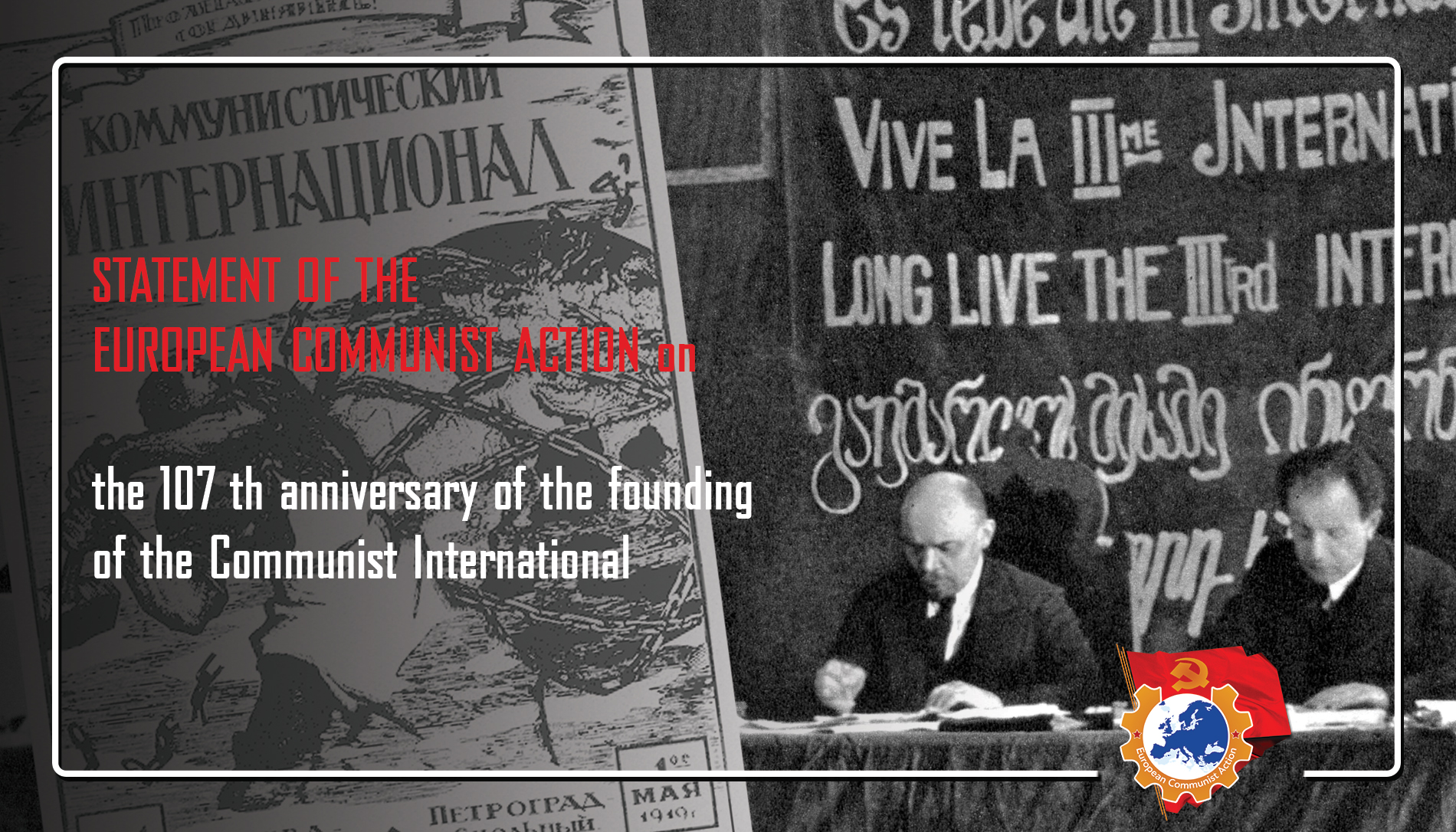
We are celebrating the 107th anniversary of the founding of the Communist International (Comintern). The founding of the International Workingmen’s Association —the First International— on 28 September 1864 was an important milestone of the revolutionary labor movement. Inspired by the Communist Manifesto and spearheaded by Karl Marx and Friedrich Engels, it brought together trade unions, mutual aid societies, political and cultural groups, and organizations. It marked the decisive break with opportunism in an international framework and guided the struggle of the world’s working class for the overthrow of capitalism, while giving impetus to the realization of the need to establish workers’ political parties. Its dissolution (1876) came after the defeat of the Paris Commune (1871) in the face of the new circumstances it found itself confronted with.
The Second International was founded on 14 July, 1889, amid rapid growth of the capitalist system and the swift rise of the labour movement. Ideological and political problems, along with the dominance of reformism, led to the collapse of the 2nd International. This was a product of the corrosion of the Workers’ Parties in the time leading up to the outbreak of the First Imperialist World War in 1914 and the eventual betrayal of the interests of the working class in favor of the bourgeoisie. Notable examples of parties that did not follow the bourgeoisie in their countries were the Bolsheviks in Russia, led by V. I. Lenin; the Internationalists-Spartacists in Germany (Karl Liebknecht, Rosa Luxemburg, Franz Mehring, etc.); and certain socialists groups in the Balkans.
The Great October Socialist Revolution proved by practical example that a workers’ revolution capable of seizing power was possible and served as a beacon that continues to illuminate the struggle of working people around the world to this day. Lenin raised the crucial need to reform the programmes of the workers’ parties, rename them as Communist Parties, and establish a new International.
The founding of the Comintern on 4 March 1919 was thus an important step in giving the revolutionary labor movement a definite organizational framework in which it could fulfill its revolutionary duties. Through its theoretical and practical intervention it made an important contribution to the forming of Communist Parties, which became the leading force for the overthrow of capitalism in many countries.
The development of the Comintern was prepared by the organization of the Zimmerwald and Kienthal conferences, in which a line of confrontation between the revolutionary labor movement and opportunism, as well as with its centrist or “left” social-democratic variety, was strengthened. Thanks to Lenin’s contribution, the contemporary epoch was characterized as the imperialist stage of capitalism and the necessary conclusion of turning the imperialist war —which threatened to break out among the imperialist states— “into a proletarian civil war against the bourgeoisie, for the purpose of establishing the dictatorship of the proletariat and socialism”, was strengthened.
Since the beginning of the imperialist War in Ukraine a similar differentiation within the International Communist Movement has taken place. We can now observe that many so-called Communist and Workers’ Parties have given up on representing the independent interests of the working class, renounce Proletarian Internationalism in favor for supporting their own bourgeoisie in imperialist conflicts and indefinitely postpone the preparation for socialist revolution by proclaiming the need to fight for various “intermediate stages”.
Throughout its history the Comintern was the world’s leading center of the struggle of the working people for socialism-communism. It made important contributions to the theory of Marxism-Leninism, which require deeper study and include the problems and contradictions in its strategy. Important problems that had a negative impact on all its members include for example the nature of imperialist war, the struggle against fascism and the capitalist system that gives rise to it, and the stance towards social democracy. Nonetheless, this does not diminish its significant contribution to the International Communist Movement until its eventual self-dissolution in 1943.
Due to its international character the working class struggle will always need a unified political leadership and strategy.
Today, as in 1919 when the Comintern was founded, we recognize that the imperialist system is the highest and decaying stage of capitalist development. The development of the productive forces to such a high level that they are in sharp contradiction with the capitalist relations of production, inhibits the possibility to use them for the satisfaction of the needs of the people. Socialism–communism is more necessary and timely than ever.
The founding and activities of the ECA based on its Founding Declaration and our world view, Marxism–Leninism, contribute to the effort to develop a common revolutionary strategy and lay the groundwork for a higher form of organization of the Marxist-Leninist pole within the international communist movement. The slogan of the Communist Manifesto remains as relevant as ever: “Proletarians of all countries, unite!”.