Date:
Mar 4, 2026
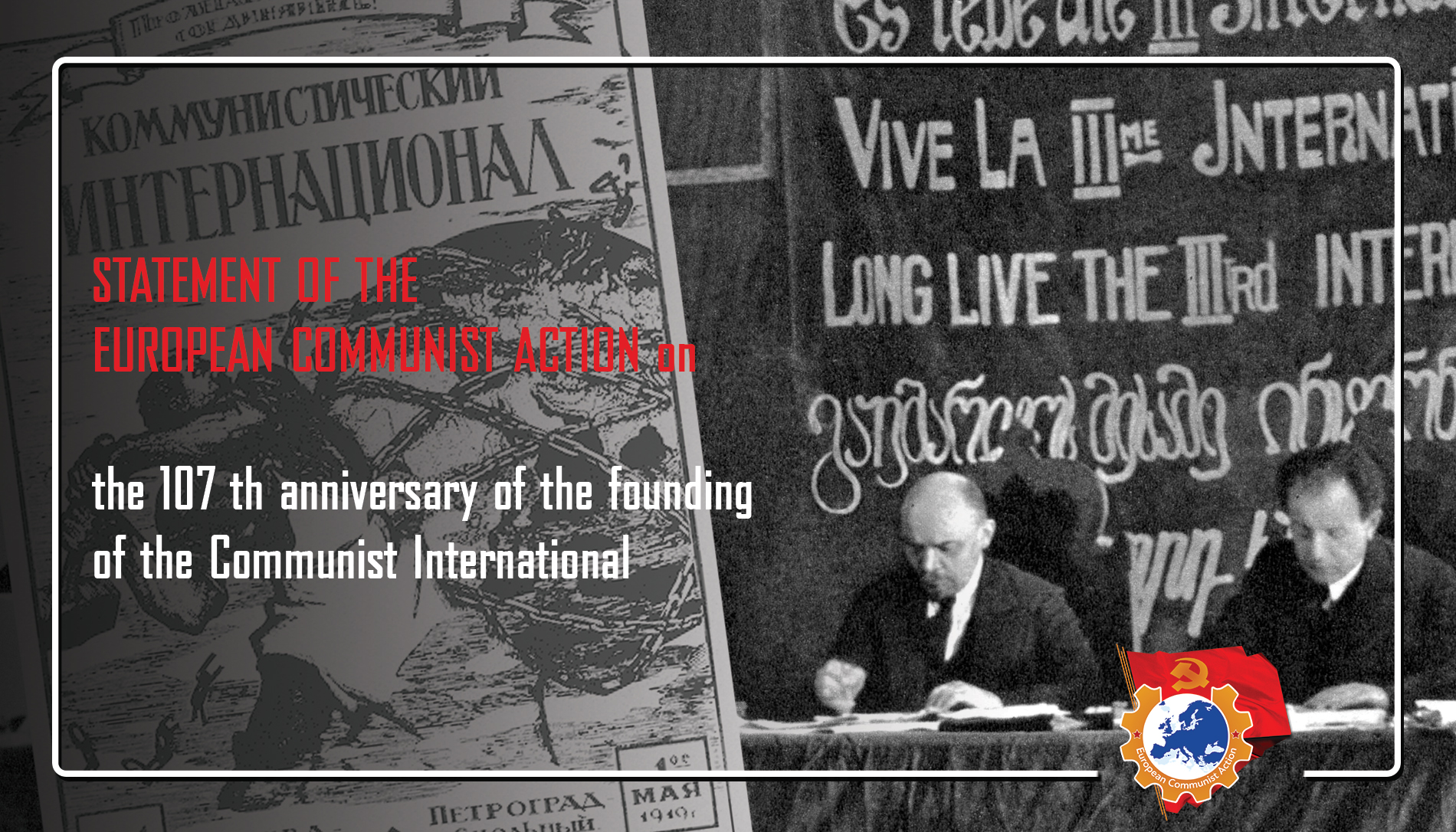
We are celebrating the 107th anniversary of the founding of the Communist International (Comintern). The founding of the International Workingmen’s Association —the First International— on 28 September 1864 was an important milestone of the revolutionary labor movement. Inspired by the Communist Manifesto and spearheaded by Karl Marx and Friedrich Engels, it brought together trade unions, mutual aid societies, political and cultural groups, and organizations. It marked the decisive break with opportunism in an international framework and guided the struggle of the world’s working class for the overthrow of capitalism, while giving impetus to the realization of the need to establish workers’ political parties. Its dissolution (1876) came after the defeat of the Paris Commune (1871) in the face of the new circumstances it found itself confronted with.
The Second International was founded on 14 July, 1889, amid rapid growth of the capitalist system and the swift rise of the labour movement. Ideological and political problems, along with the dominance of reformism, led to the collapse of the 2nd International. This was a product of the corrosion of the Workers’ Parties in the time leading up to the outbreak of the First Imperialist World War in 1914 and the eventual betrayal of the interests of the working class in favor of the bourgeoisie. Notable examples of parties that did not follow the bourgeoisie in their countries were the Bolsheviks in Russia, led by V. I. Lenin; the Internationalists-Spartacists in Germany (Karl Liebknecht, Rosa Luxemburg, Franz Mehring, etc.); and certain socialists groups in the Balkans.
The Great October Socialist Revolution proved by practical example that a workers’ revolution capable of seizing power was possible and served as a beacon that continues to illuminate the struggle of working people around the world to this day. Lenin raised the crucial need to reform the programmes of the workers’ parties, rename them as Communist Parties, and establish a new International.
The founding of the Comintern on 4 March 1919 was thus an important step in giving the revolutionary labor movement a definite organizational framework in which it could fulfill its revolutionary duties. Through its theoretical and practical intervention it made an important contribution to the forming of Communist Parties, which became the leading force for the overthrow of capitalism in many countries.
The development of the Comintern was prepared by the organization of the Zimmerwald and Kienthal conferences, in which a line of confrontation between the revolutionary labor movement and opportunism, as well as with its centrist or “left” social-democratic variety, was strengthened. Thanks to Lenin’s contribution, the contemporary epoch was characterized as the imperialist stage of capitalism and the necessary conclusion of turning the imperialist war —which threatened to break out among the imperialist states— “into a proletarian civil war against the bourgeoisie, for the purpose of establishing the dictatorship of the proletariat and socialism”, was strengthened.
Since the beginning of the imperialist War in Ukraine a similar differentiation within the International Communist Movement has taken place. We can now observe that many so-called Communist and Workers’ Parties have given up on representing the independent interests of the working class, renounce Proletarian Internationalism in favor for supporting their own bourgeoisie in imperialist conflicts and indefinitely postpone the preparation for socialist revolution by proclaiming the need to fight for various “intermediate stages”.
Throughout its history the Comintern was the world’s leading center of the struggle of the working people for socialism-communism. It made important contributions to the theory of Marxism-Leninism, which require deeper study and include the problems and contradictions in its strategy. Important problems that had a negative impact on all its members include for example the nature of imperialist war, the struggle against fascism and the capitalist system that gives rise to it, and the stance towards social democracy. Nonetheless, this does not diminish its significant contribution to the International Communist Movement until its eventual self-dissolution in 1943.
Due to its international character the working class struggle will always need a unified political leadership and strategy.
Today, as in 1919 when the Comintern was founded, we recognize that the imperialist system is the highest and decaying stage of capitalist development. The development of the productive forces to such a high level that they are in sharp contradiction with the capitalist relations of production, inhibits the possibility to use them for the satisfaction of the needs of the people. Socialism–communism is more necessary and timely than ever.
The founding and activities of the ECA based on its Founding Declaration and our world view, Marxism–Leninism, contribute to the effort to develop a common revolutionary strategy and lay the groundwork for a higher form of organization of the Marxist-Leninist pole within the international communist movement. The slogan of the Communist Manifesto remains as relevant as ever: “Proletarians of all countries, unite!”.
***
Declaración de la ACE sobre el 107º aniversario de la fundación de la Internacional Comunista
Celebramos el 107º aniversario de la fundación de la Internacional Comunista (Comintern). La fundación de la Asociación Internacional de Trabajadores —la Primera Internacional— el 28 de septiembre de 1864 fue un hito importante para el movimiento obrero revolucionario. Inspirado en el Manifiesto comunista y encabezado por Karl Marx y Friedrich Engels, unió a sindicatos, sociedades de ayuda mutua, y organizaciones y grupos políticos y culturales, suponiendo una ruptura decisiva con el oportunismo en un marco internacional y guiando la lucha de la clase obrera mundial por el derrocamiento del capitalismo a la vez que daba un impulso a la interiorización de la necesidad de establecer partidos políticos obreros. Su disolución (1876) llegó tras la derrota de la Comuna de París (1871) ante las nuevas circunstancias que tuvo que afrontar.
La Segunda Internacional fue fundada el 14 de julio de 1889, en medio de un rápido crecimiento del sistema capitalista y el auge veloz del movimiento obrero. Los problemas ideológicos y políticos, junto con la predominancia del reformismo, condujeron a la bancarrota de la II Internacional, producto de la corrosión de los Partidos Obreros en la época que condujo al estallido de la I Guerra Mundial Imperialista en 1914 y a la traición final a los intereses de la clase obrera en favor de la burguesía. Ejemplos notables de partidos que no siguieron a la burguesía en sus países fueron los bolcheviques en Rusia, dirigidos por V.I. Lenin; los internacionalistas-espartaquistas en Alemania (Karl Liebknecht, Rosa Luxemburgo, Franz Mehring, etc.); y ciertos grupos socialistas en los Balcanes.
La Gran Revolución Socialista de Octubre demostró con el ejemplo práctico que era posible una revolución obrera capaz de tomar el poder y sirvió como faro que sigue iluminando hasta el día de hoy la lucha del pueblo trabajador de todo el mundo. Lenin planteó la necesidad crucial de reformar los programas de los partidos obreros, renombrarlos como Partidos Comunistas y establecer una nueva Internacional.
La fundación de la Comintern el 4 de marzo de 1919 fue así pues un paso importante para dar al movimiento obrero revolucionario un marco organizativo definido en el que podría cumplir sus deberes revolucionarios. A través de su intervención teórica y práctica, realizó una contribución importante en la formación de Partidos Comunistas, que se convirtieron en la fuerza dirigente en el derrocamiento del capitalismo en muchos países.
El desarrollo de la Comintern fue preparado por la organización de las conferencias de Zimmerwald y Kienthal, en las que se fortaleció una línea de confrontación entre el movimiento obrero revolucionario y el oportunismo, así como con su variedad centrista o socialdemócrata “de izquierda”. Gracias a la contribución de Lenin, la época contemporánea se caracterizó como la fase imperialista del capitalismo y se reafirmó la conclusión necesaria de convertir la guerra imperialista —que amenazaba con estallar entre los estados imperialistas— “en una guerra civil proletaria contra la burguesía, con el propósito de establecer la dictadura del proletariado y el socialismo”.
Desde el inicio de la Guerra Imperialista en Ucrania ha tenido lugar una diferenciación similar dentro del Movimiento Comunista Internacional. Ahora podemos observar que muchos de los llamados Partidos Comunistas y Obreros han renunciado a representar los intereses independientes de la clase obrera, renunciando al Internacionalismo Proletario en favor del apoyo a su propia burguesía en conflictos imperialista y posponiendo de forma indefinida la preparación de la revolución socialista al proclamar la necesidad de luchar por distintas “etapas intermedias”.
A lo largo de la historia, la Comintern fue el centro mundial dirigente de la lucha del pueblo trabajador por el socialismo-comunismo, haciendo importantes contribuciones a la teoría del marxismo-leninismo que necesitan un estudio más profundo incluyendo los problemas y las contradicciones en su estrategia; problemas importantes que tuvieron un impacto negativo en todos sus miembros y que incluyen por ejemplo el carácter de la guerra imperialista, la lucha contra el fascismo y el sistema capitalista del que surge y la posición hacia la socialdemocracia. No obstante, ello no disminuye su significativa contribución al Movimiento Comunista Internacional hasta su autodisolución final en 1943.
Debido a su carácter internacional, la lucha de la clase obrera siempre necesitará una dirección política y una estrategia unificadas.
Hoy, como en 1919, cuando se fundó la Comintern, reconocemos que el sistema imperialista es la fase superior y decadente del desarrollo capitalista. El desarrollo de las fuerzas productivas a un nivel tan alto que entra en grave contradicción con las relaciones capitalistas de producción inhibe la posibilidad de usarlas para satisfacer las necesidades del pueblo. El socialismo-comunismo es más necesario y oportuno que nunca.
La fundación y las actividades de la ACE, basadas en su Declaración Fundacional y en nuestra cosmovisión, el marxismo-leninismo, contribuyen al esfuerzo de desarrollar una estrategia revolucionaria común y cimentan el terreno para una forma superior de organización del polo marxista-leninista dentro del movimiento comunista internacional. La consigna del Manifiesto Comunista sigue siendo tan relevante como siempre: “Proletarios de todos los países, ¡uníos!”
***
Заявление ЕКД по случаю 107-й годовщины образования Коммунистического Интернационала
Мы отмечаем 107-ю годовщину основания Коммунистического Интернационала (Коминтерна). Основание Международного товарищества рабочих — Первого Интернационала — 28 сентября 1864 года стало важной вехой в революционном рабочем движении. Вдохновлённый «Коммунистическим манифестом» и возглавленный Карлом Марксом и Фридрихом Энгельсом, он объединил профсоюзы, общества взаимопомощи, политические и культурные группы и организации. Основание Первого Интернационала ознаменовало решительный разрыв с оппортунизмом в международном масштабе и направило борьбу мирового рабочего класса за свержение капитализма, в то же время придав импульс осознанию необходимости создания рабочих политических партий. Его роспуск (1876 г.) произошел после поражения Парижской коммуны (1871 г.) в условиях новых обстоятельств, с которыми Первый Интернационал столкнулся.
Второй Интернационал был основан 14 июля 1889 года на фоне быстрого роста капиталистической системы и стремительного подъёма рабочего движения. Идеологические и политические проблемы, наряду с доминированием реформизма, привели к распаду Второго Интернационала. Распад был результатом разложения рабочих партий в период, предшествовавший началу Первой империалистической мировой войны в 1914 году, и в конечном итоге предательством интересов рабочего класса в пользу буржуазии. Яркими примерами партий, которые не последовали за буржуазией в своих странах, были большевики в России во главе с В. И. Лениным, интернационалисты-спартакисты в Германии (Карл Либкнехт, Роза Люксембург, Франц Меринг и др.) и некоторые социалистические группы на Балканах.
Великая Октябрьская социалистическая революция на практическом примере доказала, что рабочая революция, способная захватить власть, возможна, и послужила маяком, который до сих пор освещает борьбу трудящихся всего мира. Ленин поднял вопрос о крайней необходимости реформирования программ рабочих партий, переименования их в коммунистические партии и создания нового Интернационала.
Таким образом, создание Коминтерна 4 марта 1919 года стало важным шагом в придании революционному рабочему движению чёткой организационной структуры, в рамках которой оно могло выполнять свои революционные задачи. Благодаря своему теоретическому и практическому вмешательству он внёс важный вклад в формирование коммунистических партий, которые стали ведущей силой в свержении капитализма во многих странах.
Развитие Коминтерна было подготовлено организацией конференций в Циммервальде и Кинтале, на которых была укреплена линия противостояния между революционным рабочим движением и оппортунизмом, а также его центристской или «левой» социал-демократической разновидностями. Благодаря вкладу Ленина, современная эпоха была охарактеризована как империалистическая стадия капитализма, и был укреплён необходимый вывод о превращении империалистической войны в пролетарскую гражданскую войну против буржуазии с целью установления диктатуры пролетариата и социализма.
С начала империалистической войны на Украине в международном коммунистическом движении произошло аналогичное разделение. Сейчас мы можем наблюдать, что многие так называемые коммунистические и рабочие партии отказались от представления независимых интересов рабочего класса, отреклись от пролетарского интернационализма в пользу поддержки своей буржуазии в империалистических конфликтах и на неопределённый срок отложили подготовку к социалистической революции, провозгласив необходимость борьбы за различные «промежуточные этапы».
На протяжении всей своей истории Коминтерн был ведущим мировым центром борьбы трудящихся за коммунизм. Он внёс важный вклад в теорию марксизма-ленинизма, который требует более глубокого изучения и включает в себя проблемы и противоречия в его стратегии. К важным проблемам, которые оказали негативное влияние на всех его членов, относятся, например, природа империалистической войны, борьба против фашизма и капиталистической системы, которая его порождает, а также позиция по отношению к социал-демократии. Тем не менее, это не умаляет его значительного вклада в международное коммунистическое движение до его самороспуска в 1943 году.
В силу своего международного характера борьба рабочего класса всегда будет нуждаться в едином политическом руководстве и стратегии.
Сегодня, как и в 1919 году, когда был основан Коминтерн, мы признаём, что империалистическая система является высшей и умирающей стадией капиталистического развития. Развитие производительных сил, дошедшее до такого высокого уровня, что они вступают в резкое противоречие с капиталистическими производственными отношениями, препятствует возможности использовать их для удовлетворения потребностей народа. Коммунизм необходим и актуален как никогда.
Создание и деятельность ЕКД, основанные на Учредительной декларации и нашем мировоззрении, марксизме-ленинизме, способствуют разработке общей революционной стратегии и созданию основы для более высокой формы организации марксистско-ленинского полюса в рамках международного коммунистического движения. Лозунг Коммунистического манифеста остаётся актуальным как никогда: «Пролетарии всех стран, соединяйтесь!».