Date:
Oct 24, 2025
Europe prepares itself for war. This is clearly proven by the strategy followed, various available economic data and the statements of the governments.
All countries in present day Europe are capitalist countries and they are ruled by a single maxim — defending the interests of national monopolies— and ensuring their profits. Many of these countries have joined for the time being the European Union in an effort to improve their competitiveness against their capitalist rivals, such as China and the USA. The goal of the European Union is to defend the interests of a particular group of capitalists at a determined historical juncture.
The assessments on the militarization of the European economy are to be framed within this context. Capitalism has not been capable of reaching the rates of growth, accumulation or profit existing before the 2008 crisis. Furthermore it is threatened by the shadow of the next crisis of over-production. Clashes between capitalists for the control of markets, transportation routes, and sources of raw materials are sharpening. This is why the danger of new and more violent military conflicts between capitalist powers is exponentially increasing.
Currently all the European countries, led by the strongest ones i.e. Germany, Britain, and France are accelerating the anti-popular reforms for the increase of military expenses and to strengthen the economic sectors required to face the inter-imperialist disputes. In its report, NATO cynically tells young people that “the question is not whether they will fight, but for what future they will fight, and if they are not convinced to fight, we will have to force them to do so”.
The NATO countries have committed to reaching 5% of GDP for military spending, and many exceed 2%.
For most of the European countries, the last time such figures were seen was during wartime or right before it. For example, the last time such figures were recorded in military spending was in France, in 1953 —when it carried out colonial campaigns in Southeastern Asia and Northern Africa—; and in Germany, in 1963, while Western Germany was clashing with Socialist Germany.
The European Union is mobilizing enormous resources for war. The “ReArm Europe” plan —renamed as “Readiness 2030” for cosmetic reasons— envisages the use of €800 billions for the war industry. The rules being now adopted will enable the European countries to bypass deficit targets for military spending. Budget limits are only for social expenses, while there is no limit for military spending nor for debt payments to lenders.
Numerous European governments have confessed that such a European rearming process will have adverse effects on social expenditure. This view was expressed by the German Chancellor, Friedrich Merz, when he said that “the Welfare State can no longer be sustained”; by the Belgian Prime Minister, Bart de Wever, when he said that “The Welfare State … will collapse … unless the policies are changed”; and also by the French Minister for the Economy and Finances, Éric Lombard, when he answered whether Europe was under a war economy regime by saying that “it is not, but it should be”.
The working class in the European countries is losing rights at a rapid pace. In 2022, the real purchase power fell by a mean 4.3% — by 0.7% in 2023. More than three millions of workers are not protected by any collective agreements, due to the decline of union affiliation and the advance of laws against collective agreements. At the same time, anti-workers reforms come one after the other in a quick succession. Recently —and just to cite two examples—, the Greek Government, based on an EU directive, has promoted a 13-hour working day and the annualization of working time, and the Portuguese Government adopted a draconian Labour Reform, which increases the causes for dismissal and labour flexibility.
The working class should strongly oppose the sacrifices the capitalists demand of us to wage for the cause of their wars. We should demand no sacrifices — no involvement in the NATO and EU slaughterhouses of war, defend the wages and collective labour agreements in the workplaces we receive for our labour, and our social security rights, strongly fighting the transfer of the wealth that labour generates to the pockets of capital for their war machinery, aiming to overthrow capitalism, abolish exploitation, and intensify the struggle for socialism.
Our lives are at stake.
***
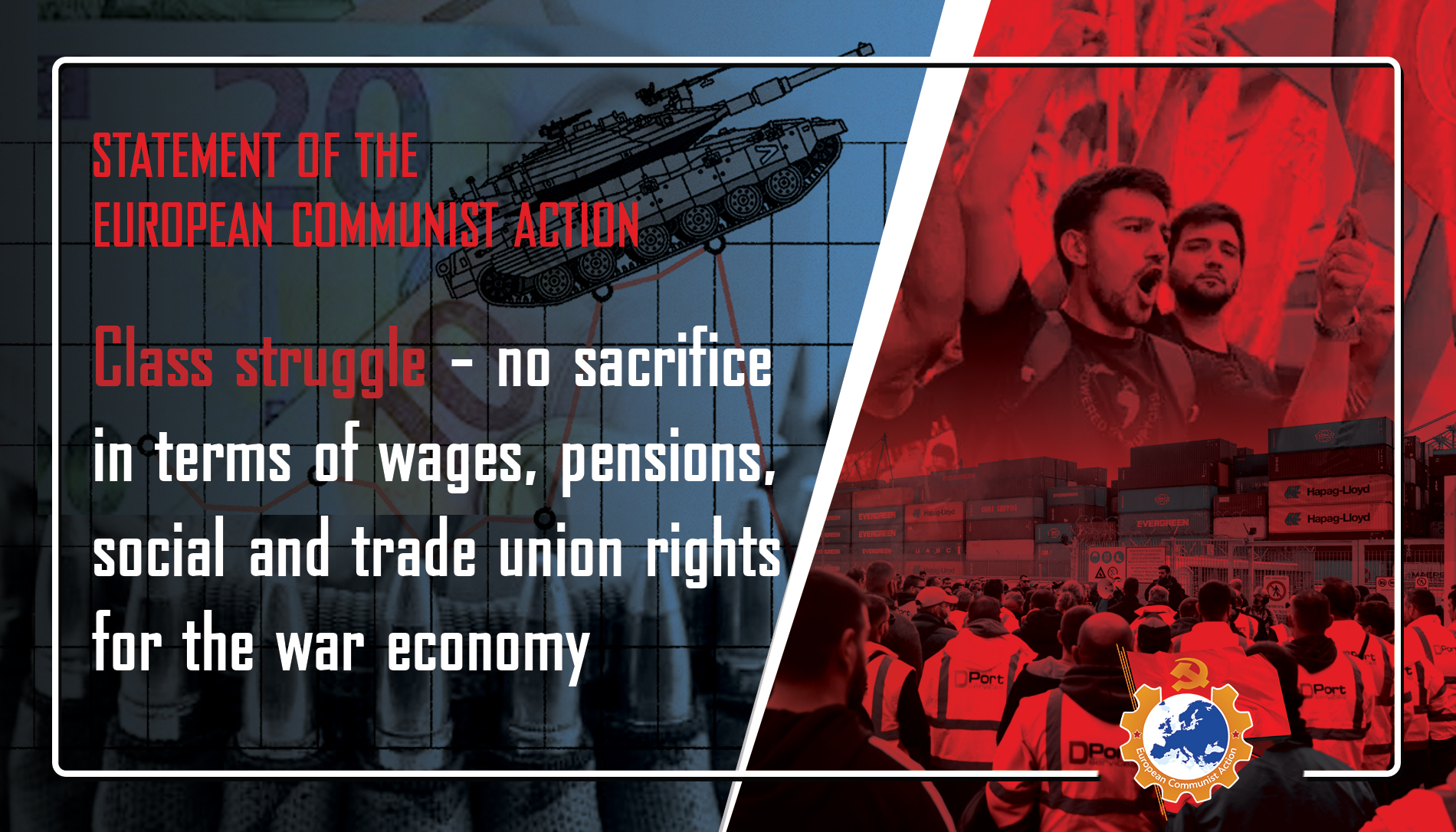
Declaración de la Acción Comunista Europea (ACE)
“Lucha de clases: ningún sacrificio en los salarios, las pensiones, los derechos sindicales y sociales para la economía de guerra”
Europa se prepara para la guerra. Así lo demuestran claramente la estrategia seguida, los distintos datos económicos disponibles y las declaraciones de los gobiernos.
Todos los países en la Europa actual son capitalistas y se rigen sólo por una única máxima: defender los intereses de los monopolios nacionales y asegurar sus beneficios. Muchos de estos países se han unido, en este momento, a la Unión Europea en un esfuerzo por mejorar su competitividad contra sus rivales capitalistas, como China y EE.UU.. El propósito de la Unión Europea es defender, en una conyuntura histórica determinada, los intereses de un grupo concreto de capitalistas.
En este contexto hay que enmarcar los análisis sobre la militarización de la economía europea. El capitalismo no ha logrado alcanzar tasas de crecimiento, acumulación o beneficios que existían antes de la crisis de 2008, y además se ve amenazado por la sombra de la próxima crisis de sobreproducción. Se agudizan los enfrentamientos entre capitalistas por el control de los mercados, de las rutas de transporte, de las fuentes de materias primas. Y es por ello por lo que aumenta exponencialmente el peligro de nuevos y más violentos conflictos militares entre potencias capitalistas.
En la actualidad, todos los países capitalistas europeos, dirigidos por los más fuertes; es decir, Alemania, Gran Bretaña y Francia; están acelerando las reformas antipopulares para aumentar el gasto militar y fortalecer los sectores de la economía necesarios para afrontar las disputas interimperialistas. En su informe, la OTAN le dice de forma cínica a los jóvenes que “la cuestión no es si lucharán o no, sino por qué futuro lucharán; y si no les convence luchar, les obligaremos a hacerlo”.
Los países de la OTAN se han comprometido a alcanzar para 2035 el 5 % del presupuesto, sobre el PIB, destinado a gastos militares y muchos de estos países ya superan el 2 %.
Para la mayoría de países europeos, la última vez que se vieron tales cifras fue en momentos bélicos o prebélicos. Por ejemplo, la última vez que se registraron tales cifras de gasto militar fue en Francia, en 1953, en el marco de sus campañas coloniales en el sudeste asiático y en el norte de África; y en Alemania, en 1963, en la confrontación con la Alemania socialista.
La Unión Europea está movilizando ingentes recursos para la guerra. El plan “ ReArm Europe”, que tuvo que ser rebautizado “Readiness 2030” por motivos cosméticos, prevé el uso de 800.000 millones de euros para la industria de guerra. Las normas que se están aprobando permitirán a los países europeos saltarse los objetivos de déficit para el gasto militar. Las limitaciones presupuestarias son únicamente para los gastos sociales y no existen para los gastos militares o para el pago de la deuda a los prestamistas.
Numerosos dirigentes europeos han confesado que dicho proceso de rearme europeo tendrá efectos adversos al gasto social. Esta perspectiva fue expresada por el canciller alemán, Friedrich Merz, cuando dijo que “el Estado del Bienestar ya no puede seguir sosteniéndose”; el Primer Ministro belga, Bart de Wever, al afirmar que “El Estado del Bienestar (....) se derrumbará (...) a menos que cambien las políticas”; y el Ministro de Economía y Finanzas francés, Eric Lombard, que respondía a la pregunta sobre si Europa está en economía de guerra diciendo “no lo está, pero debería estarlo”.
La clase obrera de los países europeos está perdiendo derechos a un ritmo muy acelerado. En 2022, el poder adquisitivo real bajó un 4,3% de media; en 2023, un 0,7%. Más de tres millones de trabajadores están fuera de la protección de cualquier convenio colectivo, ante el retroceso de la afiliación sindical y el avance de legislaciones contrarias a los acuerdos colectivos. Al mismo tiempo, se suceden las reformas antiobreras a un ritmo muy acelerado: recientemente, y por citar sólo dos, el gobierno griego, basándose en una directiva de la UE, ha promovido la jornada laboral de 13 horas y la anualización del tiempo de trabajo; y el gobierno portugués aprobó una reforma laboral draconiana que aumenta las causas de despido y la flexibilidad laboral.
La clase obrera debe oponerse contundentemente a los sacrificios que nos piden los capitalistas para librar sus guerras. Debemos exigir que no haya ningún sacrificio: ninguna implicación en las masacres bélicas de la OTAN y la UE, defensa de los salarios y los convenios colectivos que obtenemos por nuestro trabajo en los centros de trabajo y de nuestros derechos a la seguridad social, combatiendo con firmeza el trasvase de las rentas del trabajo a los bolsillos del capital para su maquinaria de guerra, aspirando a derrocar el capitalismo, abolir la explotación e intensificar la lucha por el socialismo.
Nos va la vida en ello.
***
Заявление Европейского коммунистического действия (ECA)
«Классовая борьба – Нет жертвам в области заработной платы, пенсий,
профсоюзных и социальных прав ради военной экономики»
Дата: 24 октября 2025 г.
Европа готовится к войне. Это ясно подтверждается проводимой стратегией, различными доступными экономическими данными и заявлениями правительств.
Все страны современной Европы являются капиталистическими странами и руководствуются одной максимой — защищать интересы национальных монополий и обеспечивать их прибыль. Многие из этих стран вступили в Европейский союз на время, стремясь повысить свою конкурентоспособность по отношению к своим капиталистическим соперникам, таким как Китай и США. Цель Европейского союза — защищать интересы определенной группы капиталистов на определенном историческом этапе.
Оценки милитаризации европейской экономики должны рассматриваться в этом контексте. Капитализм не смог достичь темпов роста, накопления и прибыли, существовавших до кризиса 2008 года. Кроме того, ему угрожает тень следующего кризиса перепроизводства. Обостряются столкновения между капиталистами за контроль над рынками, транспортными маршрутами и источниками сырья. Именно поэтому опасность новых и более жестоких военных конфликтов между капиталистическими державами растет в геометрической прогрессии.
В настоящее время все европейские страны, во главе с самыми сильными из них, то есть Германией, Великобританией и Францией, ускоряют антинародные реформы, направленные на увеличение военных расходов и укрепление экономических секторов, для готовности к межимпериалистическим спорам. В своем докладе НАТО цинично заявляет молодым людям, что «вопрос не в том, будут ли они воевать, а в том, за какое будущее они будут воевать, и если они не убеждены в необходимости воевать, мы будем вынуждены их заставить».
Страны НАТО обязались довести военные расходы до 5% ВВП; у многих из них военные расходы уже превышают 2%.
Для большинства европейских стран последний раз такие цифры наблюдались во время войны или непосредственно перед ней. Например, в последний раз такие цифры военных расходов были зафиксированы во Франции в 1953 году, когда она проводила колониальные кампании в Юго-Восточной Азии и Северной Африке, и в Германии в 1963 году, когда Западная Германия конфликтовала с Социалистической Германией.
Европейский Союз мобилизует огромные ресурсы для войны. План «ReArmEurope» (Перевооружение Европы)— переименованный в «Readiness 2030» (Готовность 2030) из косметических соображений— предусматривает использование 800 миллиардов евро для военной промышленности. Принимаемые в настоящее время правила позволят европейским странам обойти отстающие целевые показатели для военных расходов. Бюджетные ограничения касаются только социальных расходов, в то время как для военных расходов и выплат долгов кредиторам ограничений нет.
Многие европейские правительства признали, что такой процесс перевооружения Европы будет иметь негативные последствия для социальных расходов. Эта точка зрения была высказана канцлером Германии Фридрихом Мерцем, который заявил, что «государство всеобщего благосостояния больше не может существовать»; премьер-министр Бельгии Барт де Вевер, который заявил, что «государство всеобщего благосостояния <...> рухнет <...> если не будет изменена политика»; а также министр экономики и финансов Франции Эрик Ломбар, отвечая на вопрос, находится ли Европа в режиме военной экономики, сказал, что «нет, но должна быть».
Рабочий класс в европейских странах стремительно теряет свои права. В 2022 году реальная покупательная способность снизилась в среднем на 4,3%, в 2023 году — на 0,7%. Более трех миллионов работников не защищены никакими коллективными договорами из-за снижения членства в профсоюзах и продвижения законов, направленных против коллективных договоров. В то же время антирабочие реформы следуют одна за другой в быстрой последовательности. Недавно — и это только два примера — правительство Греции, основываясь на директиве ЕС, продвигало 13-часовой рабочий день и переход на годовую систему учета рабочего времени, а правительство Португалии приняло драконовскую трудовую реформу, которая увеличивает количество причин для увольнения и гибкость труда.
Рабочий класс должен решительно противостоять жертвам, которые капиталисты требуют от нас ради своих войн. Мы должны требовать, чтобы от нас не требовали никаких жертв — никакого участия в кровавых войнах НАТО и ЕС, должны защищать заработную плату и коллективные трудовые соглашения на рабочих местах, которые мы получаем за наш труд, а также наши права на социальное обеспечение, решительно бороться против перехода богатства, созданного трудом, в карманы капитала для его военной машины, стремиться к свержению капитализма, отмене эксплуатации и усилению борьбы за социализм.
На карту поставлены наши жизни.