
Date:
Oct 13, 2026
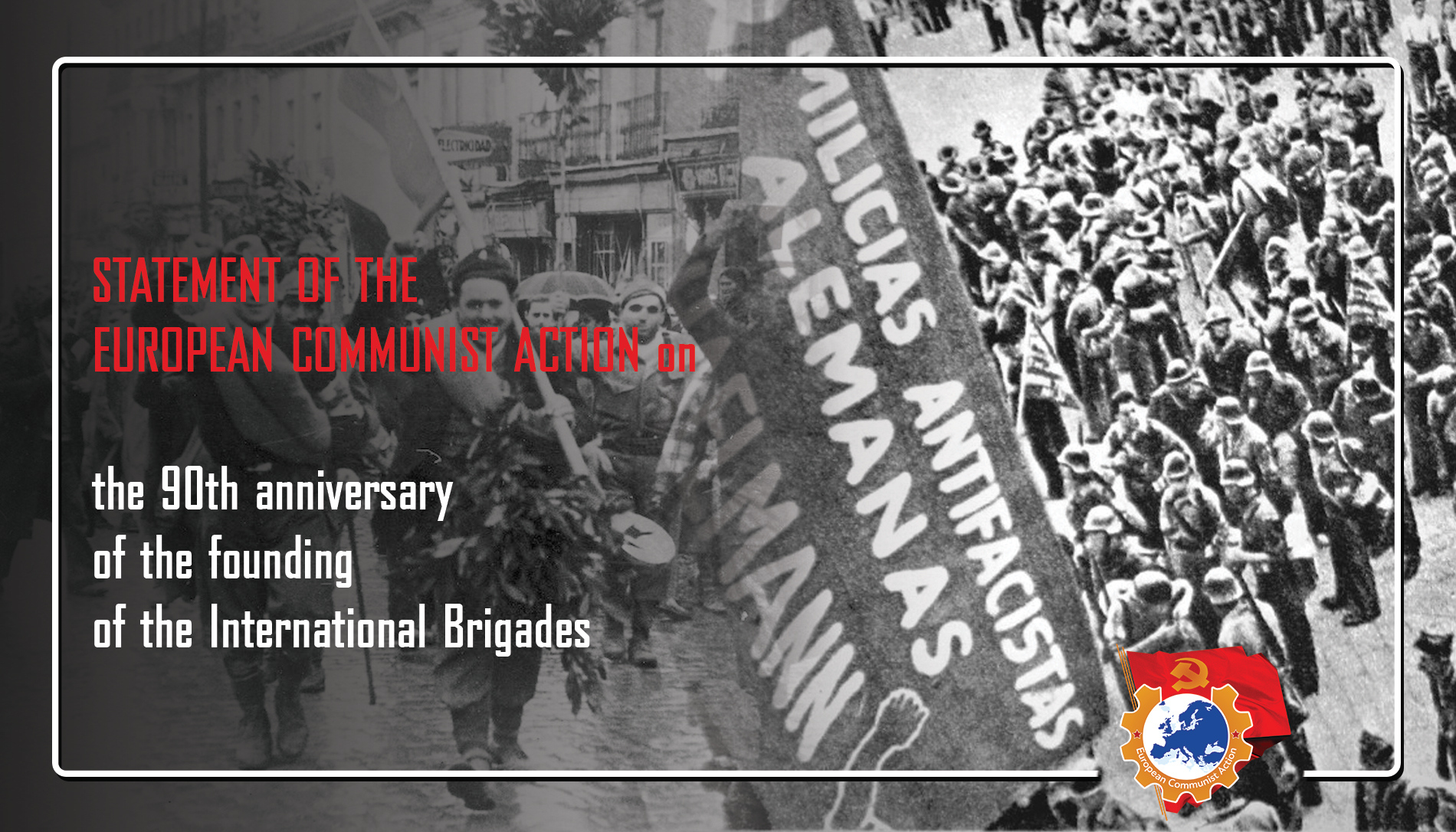
The European Communist Action commemorates the 90th anniversary of the founding of the International Brigadesandthe heroic sacrifice of thousands of working men and women who left behind theirown countries, theirjobs, their families and their homes to fight fascism in Spain, whilst many of the Communist Parties to which they belonged were operating in clandestinity. Their courage remains a point of reference for the struggle of the working class to this day, and their experience also offers valuable political lessons that we must not forget.
On 14th October 1936, the first international brigadists arrived in Albacete. The arrival of the brigadists in Spain is one of the clearest historical examples of proletarian internationalism, brought about through the political and organisational initiative of Communist Parties from around the world. It must be emphasised that the Soviet Union was the main supplier of arms to Republican Spain and, without a doubt, the driving force behind the internationalist aid that reached the Spanish people from every corner of the globe throughout the war.
The International Brigades came into being as a result of the decision taken by the Executive Committee of the Communist International on 18th September 1936. An international recruitment centre was immediately established in Paris, in which the French Communist Party (PCF) and the Italian Communist Party (PCI), then in exile, played a fundamental organisational role.
Over the course of the war, as many as 35,000 workers from more than 53 countries across Europe, the Americas, Asia and Africa went to spain. Some were unable to return to their homes, facing repression in the workplace, administrative difficulties and even imprisonment.
During the war against fascism in Spain, the International Brigades took part in decisive battles such as Madrid, Guadalajara, Belchite, Teruel, Caspe and the Ebro. In each of these battles, they left an indelible mark, as well as an example of selflessness and sacrifice.
The role of the International Brigades in the war in Spain reminds us that, when confronted by a powerful enemy, sometimes even a stronger one, victory can be achieved through the mobilisation of the forces of the working class and its spirit of sacrifice. At the Battle of Guadalajara, the fascists’ initial material superiority—with more artillery, more machine guns, more vehicles and more motorised units than the antifascists—was overcome by the heroic resistance of the working class. The International Brigades played an important role in that battle, which clearly demonstrated the international character of the war. There, the fascist units of Mussolini’s Corpo Truppe Volontario came face to face with the Italian brigadists of the Garibaldi Battalion of the XII International Brigade.
After the war, the brigadists had to face the harsh consequences of defeat, just as Spanish workers did. Some were confined in the brutal Spanish concentration camps, where they were subjected to degrading conditions and torture. Others were summarily executed. Some brigadists were also deported to the infamous Nazi concentration camps. Most of them died in captivity.
The withdrawal of the International Brigades from the war against fascism in Spain must be a subject of analysis for the Communist and Workers’ Parties. Despite the prominent role played by the brigadists in the war, numerous forces within the Republican camp sought at every turn to limit their capabilities out of fear of the Communist International. One example was Indalecio Prieto’s attempts to weaken the Brigades organisationally, particularly after the Battle of Belchite. In May 1938, the President of the Republican Government, Juan Negrín, published his famous “Thirteen Points”. In these “Thirteen Points”, Negrín called for conciliation with the democratic bourgeois governments. He sought to defeat fascism through international action, disregarding the bourgeois class character of fascism.
In October of that year, Negrín announced before the League of Nations the unilateral withdrawal of the International Brigades from Spain. He hoped that the governments of the bourgeois democracies would then demand the withdrawal of the invading forces of the fascist countries. He disregarded the fact that the democracies had already made it clear through their policy of 'Non-Intervention' that the fundamental contradiction was not between 'democracy' and 'fascism', but between the class interests of the bourgeoisie and those of the working class.
In particular, the bourgeois governments of the United Kingdom and France did not demand that the fascist countries withdraw their troops from Spain. Furthermore, one week later, on 30 September, they signed the Munich Agreement with Hitler, which permitted the invasion of part of Czechoslovakia.
The experience of the International Brigades therefore leaves us valuable lessons for the struggle today. It teaches us that both bourgeois democracy and fascism are forms of managing a rotten, exploitative system. They both have the same class character: they support the profits of big capital and run counter to the interests of the working class. It teaches us that the essence of the anti-fascist struggle is the anti-capitalist struggle, because only the working class can wage a consistent struggle against fascism by fighting the system that gives rise to and sustains it: capitalism. Fascist, far-right forces were, and remain today – as recent developments confirm – a valuable reserve for the bourgeois management of capitalist barbarism, and a necessary weapon for every bourgeoisie to intensify repression against the class-based labour movement, and to promote the ahistorical theoryof the‘two extremes’ and anti-communism.
The history and contribution of the International Brigades teach us that workers from different countries, despite speaking different languages, express their internationalist solidarity even with weapons in hand, fighting alongside other peoples, defend the same class interests and constitute a single force.
Examining the experience in Spain and other countries reveals that the decisive factor in the communists' struggle as the vanguard of the class struggle is developing a revolutionary strategy. This is in opposition to the corrosive role of opportunism and social democracy. The strategy must not attempt to restore the functions of the capitalist system, but instead turn against it in order to overthrow it. This will allow the working class to seize power and establish socialism.
On 28th October 1938, the International Brigades bid farewell to Spain in a moving ceremony in Barcelona. The farewell words of Dolores Ibárruri, La Pasionaria, the historic Spanish communist leader, still echo in our ears:
“When the olive tree of peace blossoms, return to our side. Here, those of you who have no homeland will find a homeland; those of you who have had to live deprived of friendship will find friends; and all of you, all of you, will find the affection and gratitude of the entire Spanish people (...)”
Long live the International Brigades! Long live proletarian internationalism!